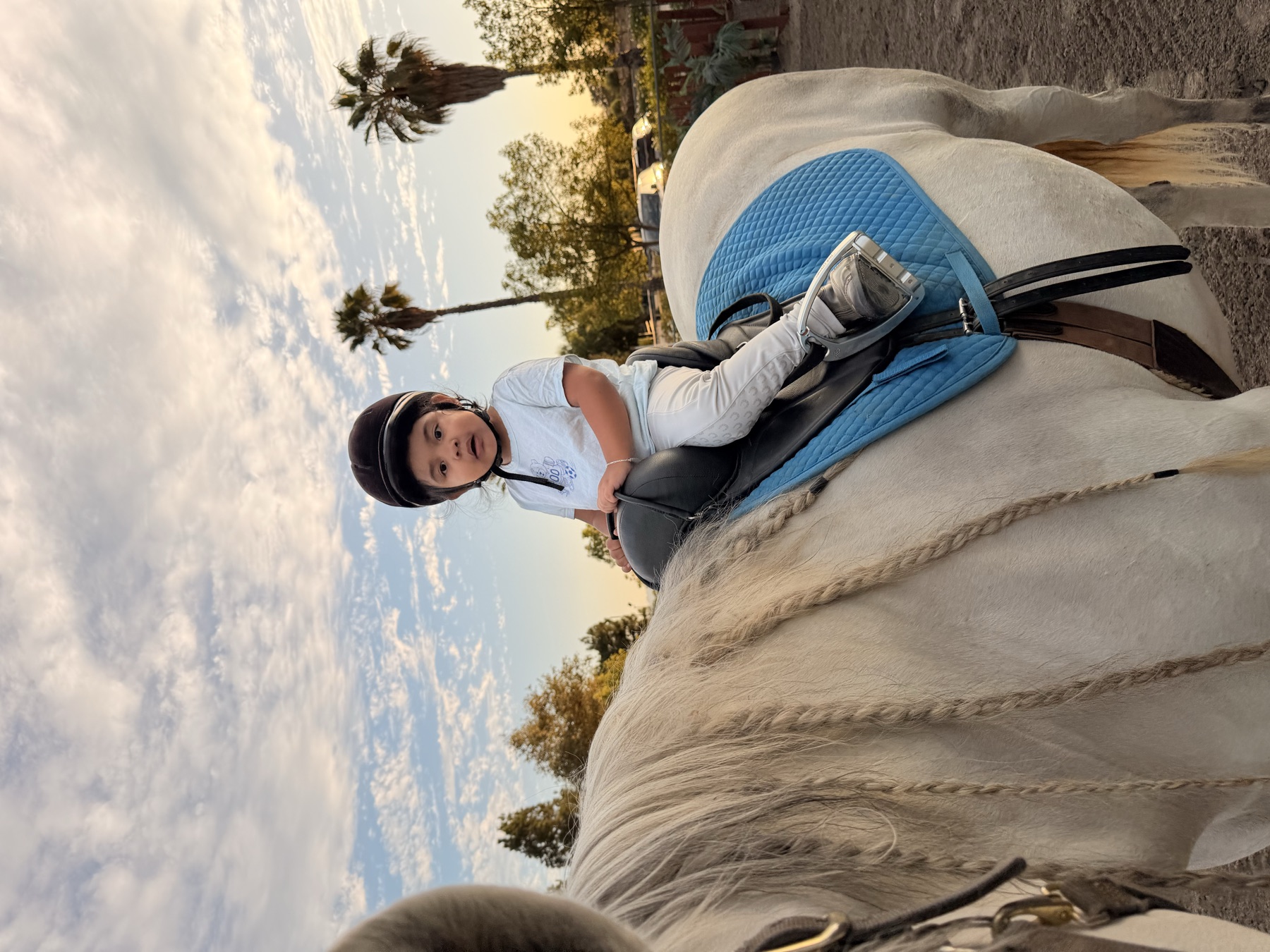
The Hussar curriculum, explained: every level, every skill, and the four centuries of classical European horsemanship behind each one. Read the chapter for your level before your lesson, and again after. The arena will make the words true; the words will make the arena make sense.
I. The Promise · II. The Lineage · III. The Two Scales · IV. The Six Strands
Part Two — The Levels
Level 0 through Level 10, each skill described
Part Three — The Library
What to read next, in order
I.The Promise
Everything in this program exists to produce three results, in this order: a rider who is soft on the horse's mouth and back; a rider who is secure in the saddle and unlikely to fall or be hurt; and horses that get better, not worse, from being ridden by our students. Every choice that follows — the long months on the lunge line, the early two-point, the obstacles, the modest fences, the work in hand — is downstream of those three commitments. None of it is decoration and none of it is tradition for tradition's sake. Where we follow the old schools, it is because the old schools were right; where we borrow from the cavalry or the modern sport, it is because they solved problems the riding academies never had to face.
The oldest surviving book on riding makes the case for softness on its first pages. Xenophon, the Athenian cavalry officer writing around 350 BC, argued that nothing forced can ever be beautiful — that a horse compelled by pain shows no more grace than a dancer compelled by a whip. Twenty-three centuries of horsemanship have added technique to that idea without ever improving on it. It is the founding sentence of the classical tradition, and it is the founding sentence of this barn.
We should also say plainly what this curriculum is not. It is not a trick-riding program, and it is not show business. The classical tradition we follow is the European academic and cavalry line — Vienna, the German school, the French school, the Italian forward seat — in which every movement exists because it makes the horse stronger, straighter, and more pleasant to ride, and can be traced to a training logic older than any of us. A movement performed for spectacle, on a tense horse, by force or shortcut, is the opposite of what we do here, whatever name it performs under.
II.The Lineage
When your instructor asks for shoulder-in, you are being handed something with a documented three-hundred-year pedigree. It helps to know where each piece of the program comes from, because the curriculum is not one school — it is a braid of five, each contributing what it did best.
Athens, 350 BC — the ethic
Xenophon, On Horsemanship. The first writer to insist that the horse's mind is the medium we work in: reward promptly, never act in anger, and understand that what is forced cannot be beautiful. Every Horse Check in our tests is Xenophon with a scoring box.
Naples and Versailles, 1550–1733 — the academy
Riding became an art with a literature in Renaissance Italy, and became a kind art in France. Antoine de Pluvinel, riding master to King Louis XIII, broke with the harsh methods of the early Italian school and taught that the horse must take pleasure in its work, or the work is worthless — he is the tradition's great early voice for patience. A century later François Robichon de la Guérinière published École de Cavalerie (1733), the single most influential riding book ever written. He gave us the modern balanced seat and, above all, shoulder-in, which he considered the first and last lesson for a horse — the exercise you will meet at Level 4 and never stop riding. The Spanish Riding School of Vienna regards his book as its foundation text to this day.
Vienna, 1572–today — the proof it works
The Spanish Riding School is the tradition's living laboratory: four and a half centuries of unbroken practice, with horses performing soundly into their twenties — the strongest longevity evidence any training system has ever produced. Vienna gave our curriculum its cornerstone: the new rider spends months on the lunge line without reins or stirrups until the seat is independent, because a hand can only ever be as good as the seat behind it. Alois Podhajsky, the school's postwar director and an Olympic medalist, wrote the tradition's modern summary, The Complete Training of Horse and Rider, and popularized the old masters' motto — the one hanging over this whole program:
"I have time."The old masters' maxim, via Podhajsky
Germany, 1885–today — the system
Gustav Steinbrecht's Gymnasium of the Horse distilled the academic tradition into a gymnastic logic — every exercise develops the horse's body toward carrying a rider well — and gave the German school its famous directive:
"Ride your horse forward and set it straight."Gustav Steinbrecht
His line of thought became the cavalry manual H.Dv.12 and then the German National Federation's Principles of Riding — the most systematized rider education in the world, organized around the training scale you will find in the next chapter. When our curriculum sequences rhythm before contact, straightness before collection, and the curb bit after self-carriage, it is speaking German.
France, 1830–1970 — the lightness
The French school is the tradition's conscience on the subject of the hand. François Baucher — a controversial genius — left us the principle of never using hand and legs at once, and the descente de main: the yielding of the hand that proves the horse is carrying itself rather than being carried. His student's student, General Alexis L'Hotte, commanded the Cadre Noir at Saumur and compressed the whole art into three words that our instructors will say to you in exactly this order for eleven levels:
In the twentieth century Nuno Oliveira — a Portuguese master working squarely in the Guérinière-French line, revered across Europe — made lightness the explicit measure of all schooling: the horse in true self-carriage, ridden by weight and breath, the aids invisible. Our Level 10 is his standard.
Italy and America, 1900–1971 — the forward seat
At the turn of the twentieth century an Italian cavalry instructor, Federico Caprilli, noticed what centuries of manège riding had not needed to know: over fences and across country, the rider's weight must come off the horse's back and follow the horse's balance, not fight it. His forward seat — folded hip, weight into the heel, hand yielding along the neck — swept every cavalry in the world within twenty years. It reached America through Fort Riley and through Russian émigré Vladimir Littauer (Common Sense Horsemanship), then became the polished American hunter seat system of Gordon Wright and George Morris (Hunter Seat Equitation). This is where our early and frequent two-point comes from: it is the fastest honest way to teach a rider to balance over their feet at trot and canter while leaving the horse's back and mouth entirely alone. The German school itself teaches its young riders a light seat for the same reason. When you are in two-point holding mane at Level 1, you are riding in Caprilli's revolution.
Europe, 1996 — the audit
Working Equitation was created as a sport in 1996 by four European nations — Portugal, Spain, France, and Italy — to preserve and test the horsemanship of Europe's working traditions. Its Ease of Handling phase is dressage among obstacles: gates, bridges, slaloms, ridden and judged on rhythm, bend, and softness. We compete under USAWE standards, but the deeper reason obstacles run through our curriculum is philosophical: an obstacle is an honest examiner. A shoulder-in on the rail can be approximated; a gate that opens calmly, from a horse standing parallel and immobile, cannot. The obstacle never flatters. That is why every obstacle in our tests is scored on the quality of the flatwork inside it — completing the obstacle on a braced, hollow horse scores nothing at Hussar, exactly as it scores nothing in a European ease-of-handling arena.
Why no "dancing horse" work?You may see horses locally performing showy, high-stepping routines under names borrowed from the classical world. Whatever the label, work produced by tension, gadgets, or fear is not classical riding — it fails the first test every master from Xenophon to Oliveira agreed on: the horse must be calm, and the movement must make the horse sounder, not lamer. Our lineage runs through the academies and cavalries of Europe, and our proof is the Horse Check, not applause.
III.The Two Scales
Two ladders run through everything we do — one for the horse, one for the rider. Learn them now; every lesson you ever take here is a rung on one of them.
The training scale — the horse's ladder
The German school's Skala der Ausbildung orders the horse's development in six stages, each depending on the ones below:
Rhythm (Takt) — pure, regular footfalls in every gait. Nothing is right if the rhythm is wrong.
Relaxation (Losgelassenheit) — the loose, swinging back; mental and muscular calm. This is the rung our Horse Check guards at every level.
Contact (Anlehnung) — a soft, steady connection the horse seeks, never a hold the rider takes.
Impulsion (Schwung) — thrust from the hindquarters traveling through that swinging back.
Straightness (Geraderichten) — hind feet following front feet, both sides evenly developed. This is what the lateral work is for.
Collection (Versammlung) — the haunches lowered and carrying, the forehand light. The top of the ladder, which is why it is the top of our curriculum.
Notice what the scale implies: collection is a result, not a posture. A horse pulled into a shape has been given the sixth rung without the five below it, and the scale names exactly what was stolen: rhythm, relaxation, honest contact, impulsion, straightness. When your instructor seems obsessed with rhythm at Level 2 while you want to canter, this ladder is why.
The seat scale — the rider's ladder
The rider climbs a parallel ladder, assembled from Müseler, the German seat lessons, and the forward-seat school:
Balance — staying with the horse by poise, not grip. Built on the lead line and lunge, where there are no reins to steal from.
Suppleness — a body that follows motion instead of bracing against it.
Independence — seat, hands, and legs able to act separately: the hand still while the hip swings, the leg active while the hand yields.
Influence — only now can aids shape the horse, because only now are they messages rather than accidents.
Wilhelm Müseler's Riding Logic — the classic German primer — is built on one observation: a rider who has not reached independence cannot have good hands, no matter how kind their intentions, because every wobble of the body arrives in the horse's mouth. This is why we do not hand you reins on day one. It is not a hazing ritual; it is arithmetic.
The Horse Check — relaxation, graded
Most programs assume the horse's well-being; ours grades it. At the end of every test, at every level, three things happen:
The stretch. The rider slowly offers the reins, and the horse — if its back was honestly swinging — chews the reins forward and down out of the hands, nose reaching toward the sand, rhythm unchanged. The German school calls this Zügel aus der Hand kauen lassen and treats it as the lie detector of dressage: a horse that worked hollow or braced has nothing to stretch into, and the test shows it instantly. You will learn to ride it at walk at Level 2, at trot at Level 3, and at canter by Level 6, and you will be graded on it forever after.
The stand. The horse halts and stands immobile on a light rein — soft eye, level ears, quiet tail, even breathing — and the rider can name each sign.
The comparison. From Level 6 upward, the examiner records the horse's state at the start and end of the ride, and the horse must finish calmer than it began. At Level 10 this comparison is the exam. The final line of our curriculum — the horse finishes more relaxed, sound, and confident than it started — is not a slogan. It is a scoring rubric.
And one rule above allA skill performed on a tense horse is not yet a skill. Any movement, obstacle, or fence completed with sustained tension is marked not yet, regardless of technical execution. This single rule keeps every other page of the curriculum honest.
IV.The Six Strands
Each level draws from six strands. Here is why each one exists — and why we will not let you skip any of them.
1 · Seat & Balance — why so long on the lunge
Vienna keeps a new rider on the lunge, without reins or stirrups, for months — Podhajsky's own figure was about half a year — and returns even its senior riders to the lunge for tune-ups throughout their careers. We do the same, scaled to a modern lesson schedule, and for the same three reasons. First, softness: reins used for balance are pain delivered by accident, and the only permanent cure is a seat that never needs them. Second, safety: nearly every beginner fall starts as a balance loss the rider tries to fix with the reins — which stops the horse's head, not the fall. A rider whose balance lives in their seat and feet simply comes off less. Third, the horses: lesson horses stay sound and generous when their mouths and backs are not the student's handrail. When you feel impatient on the lunge — and you will — remember that you are being taught in the most expensive way there is: the way that protects the horse while you learn. One consequence deserves its own sentence: at Hussar the two-point always comes before the sitting trot. Riders meet the trot and canter balanced over their feet, and sit only when the seat can follow without bouncing — because the alternative is a seat learned at the price of the horse's back. And note the quiet corollary: at every level of this program, including the highest, riders go back on the lunge without stirrups. It is not remedial. It is what Vienna does.
2 · Flatwork — the dressage spine
The flatwork strand simply walks the training scale upward: rhythm and school figures first, then transitions and honest contact, then lateral work for straightness, then collection. Its sequence — leg yield, shoulder-fore, shoulder-in, haunches-in, half-pass, pirouette, flying change — is the German school's order, with Guérinière's shoulder-in as the hinge of the whole thing. Nothing exotic, nothing invented here: just the syllabus that every serious European federation teaches, done patiently.
3 · In-Hand — the ground is a classroom
The old schools never made horses only from the saddle. Work in hand — leading, lungeing, lateral work from the ground, and long-reining — runs from Level 0 to Level 10 for four reasons. A rider on the ground can see what the hind legs do, which transforms what they later feel. A movement taught in hand first (turn on the forehand at Level 2, rein-back at Level 3, shoulder-in at Level 4) is learned by the horse and understood by the rider before a single rein aid is applied — gentler for both. Lungeing correctly is itself a classical art the student must own by Level 4, because it is how horses are made and maintained. And from Level 6 the strand rises into long-reining and, for those who want it, in-hand half-steps at the top levels — the quiet, ancient door to collection, walked on foot, exactly as Vienna walks it.
4 · Gymnastic Jumping — cavalletti, grids, and courage
We jump — and we jump the way the classical and cavalry traditions jump: low, rhythmic, and for the good of both bodies. Reiner Klimke — Olympic dressage champion and lifelong advocate of cavalletti — trained even his Grand Prix horses over poles and small fences, because pole work strengthens the back, activates the joints, steadies the rhythm, and refreshes the mind. For the rider, a grid is the most honest balance teacher ever built: the distances are set, the horse does the arithmetic, and the rider's only job is to stay in the middle and interfere with nothing — which is why our grids are ridden in two-point, on a neck strap, and eventually with knotted reins and arms out, the old cavalry proof. Heights are capped low on purpose (nothing above 2'9" is ever required) because height changes the risk but not the lesson. The lesson is always the same: the rhythm does not change.
5 · Working Equitation — the audit
Obstacles are where flatwork goes to be told the truth. The slalom is counter-bending and balance; the drums are a 10-meter circle with witnesses; the bridge is relaxation you can hear in the hoofbeats; the gate is rein-back, turn on the forehand, immobility, and patience assembled into ninety seconds of undeniable evidence. This is why WE obstacles appear as early as Level 2 and never leave — and why they are always scored on the dressage inside them, never on completion, and never on speed until the highest levels, where the speed phase is ridden as efficiency, not haste. If the flatwork strand is the textbook, this strand is the exam — and horses, unlike textbooks, enjoy it.
6 · Horsemanship — the whole animal
Xenophon devoted as much ink to the stable as to the seat. A rider who cannot see heat in a leg, name the signs of colic, judge sweat and breathing, fit a saddle, or wrap a bandage is a passenger, not a horseperson. This strand runs from grooming at Level 0 to session design, first aid, and conditioning theory in the middle levels, and culminates at Level 10 in the teach-back — because the tradition survives only if every generation can hand it on.
L0Balance Before Everything
Level 0 asks one thing of you: learn to sit a moving horse in balance, with nothing in your hands to steal from. Everything is on the lead line, an instructor at the horse's head. There are no reins because there is nothing yet a rein could honestly say. Vienna starts its riders this way; so did every cavalry; so do we. What follows is each skill and what it is really teaching.
Mounting and dismounting. Always from a block — not for your convenience, for the horse's spine and the saddle's tree, which mounting from the ground torques measurably. Both sides, because a horse handled only from the left is half-educated, and so is its rider. The horse standing quietly throughout is the first Horse Check of your riding life.
The base position at halt. Ear, shoulder, hip, and heel on one vertical line — the alignment Guérinière drew in 1733 and every school since has kept, because a rider stacked over their own skeleton needs no grip and no rein to stay on. Your instructor will return you to this line ten thousand times. That is the job.
Balanced walk with arms free. The walk swings your pelvis left-forward, right-forward. Your first task is to allow it — to discover that following motion, not resisting it, is what keeps you on. Arms out to the sides prove nothing is held.
Gymnastic exercises at walk. Arm circles, torso twists, toe touches, ankle rolls — straight from the lunge lessons of the German school. Each exercise briefly disorganizes you so your balance must reorganize deeper. A rider who can twist and reach while walking has a seat that belongs to them, not to stillness.
The eyes-closed walk. With sight removed, you feel what you have only been watching: four beats, the barrel swinging, each hind foot landing. You will name which hind foot is landing — the beginning of the feel that, at Level 3, tells you which canter lead you are on without looking.
Two-point at halt and walk. Your first taste of Caprilli's forward seat: fold at the hip, weight down into the heel, hands in mane. This is the position that frees the horse's back — and it is also a leg-strength honesty test, because in two-point there is nothing to sit on. We start it now so that by the time you trot, your legs already know their job.
No-stirrup walk. The leg hangs long, the seat deepens. Stirrups, you will discover, are a place to rest weight — not a way to stay on.
First trot steps — in two-point. Short sets on the lead, standing in the stirrups with hands in the mane or strap. The trot bounces, and a beginner's bounce lands squarely on the horse's back — so at Hussar you meet the trot the forward-seat way: balanced over your feet, the horse's back left entirely alone. Sitting the trot is a privilege your seat will earn at Level 3, not a starting point. Holding mane is permitted here precisely so the reins never learn the habit — this is the last level where your hands hold anything at all.
Tuck-and-roll, and the emergency dismount. We teach falling before we risk it, on the ground, on soft footing: chin tucked, shoulder rounded, roll and clear. Then the emergency dismount at halt and walk — kick both feet free, swing off, land bent-kneed, facing forward. Riders who have rehearsed the exit are measurably safer and visibly braver. This is the curriculum's safety promise made physical: we cannot guarantee you will never come off a horse; we can guarantee you will know how.
Leading, halting in hand, and safe zones. The in-hand strand begins at its true beginning: walk at the shoulder, lead loose, halt from your body language, and know where a horse cannot see you and where a startled horse will move. Horses read posture all day long; from your first week, yours will be saying something on purpose.
Grooming, parts, and turnout. Curry, brush, pick feet; name the parts of horse and tack on a living animal; walk a horse to its field with manners at the gate. Xenophon's chapters on the stable come before his chapters on the seat, and ours do too.
The masters behind Level 0Vienna's riderless-rein lunge tradition (Podhajsky); Müseler's seat-before-hands arithmetic; Caprilli's balanced position over the feet; Xenophon's stable-first horsemanship. You are one week into riding and already standing on four schools.
L1The Hand Is Born from the Seat
At Level 1 two things happen at once, and the tension between them is the whole level: the lunge work gets harder — trot in two-point, posting mechanics, eyes closed — while your hands are given reins for the first time. The rule that governs both is absolute and will never be repealed: the reins are never, under any circumstances, used for balance. There are deliberately no obstacles at this level. The foundation gets the level to itself.
The trot in two-point — never sat. At this level every stride of trot is ridden in two-point or posting, and none of it is sat. The reason is the horse: a rider who cannot yet follow the trot's double-beat bounces, and every bounce lands on the horse's back. The forward seat exists to take the spine out of that equation while your balance forms. The sitting trot is not skipped — it is deferred: it arrives at Level 3, on the lunge, once your body can follow instead of pound. No horse at Hussar is ever the surface a seat gets hammered out on.
Posting mechanics on the lunge. Rising trot, learned with no reins: let the horse's push send you forward-and-up out of the stirrup and thigh, and return softly. Learned this way, posting never involves the hands — which is the point of learning it here rather than out on the rail.
Two-point at trot. First holding the neck strap, then arms out. The heel deepens, the knee softens, the torso quietly balances over the foot. This is Caprilli's position doing its double duty: building your leg while sparing the horse's back and mouth during the exact months you are least able to spare them yourself.
Gymnastics and the eyes-closed trot. The Level 0 exercises, now at trot, plus riding by feel alone. Rhythm is becoming something you keep rather than something you watch.
Emergency dismount at trot. The exit, rehearsed at speed. After this level it becomes a maintained skill — practiced periodically forever, like the lunge tune-up.
The correct rein hold and the elastic elbow. Now, at last, the reins — held so a straight line runs from your elbow through your hand to the bit, thumbs up, fingers closed as around a small bird: firmly enough to keep it, softly enough not to hurt it. The elbow, not the fingers, is where softness lives: it opens and closes with the horse's neck at walk like a hinge. You will spend the rest of your riding life defending this line.
Halt from the seat. Breath out, seat stops following, rein — last, lightly, and only if needed. On the lunge first, where the instructor guarantees the outcome, then off. A horse halted from the seat halts square and calm; a horse halted from the hand halts braced. Every downward transition you ever ride is this skill scaled up.
Opening and direct rein at walk. The two simplest rein effects, used with the neck soft and the hands never crossing the withers. Steering, you will find, is mostly the seat and eyes anyway; the rein confirms what your body already asked.
School figures at walk. A large circle and a change across the diagonal, off the lunge, accurate to the letter. Accuracy is not pedantry — a circle that drifts is a horse that fell out through a shoulder nobody caught. Figures are how riders learn to feel straightness, one bulge at a time.
Free walk on a long rein. You offer length; the horse takes it, neck reaching. Your hands follow forward without dropping the connection. This unglamorous skill is the seed of the stretch that the Horse Check grades at every level above this one.
The drop-and-recover drill. Mid-stride on the lunge, you surrender the reins to the neck strap — and nothing about your balance changes, because nothing about your balance ever depended on them. This drill is the level's thesis made visible, and it is in the test.
In hand: trot, turns, and a step back. Leading at trot with prompt voice transitions; turning the horse away from you for safety; one step of rein-back from a light chest cue. The ground work is quietly building the vocabulary — voice, posture, light pressure released instantly — that lungeing will need at Level 2.
Tacking up, and the bit in the mouth. You tack up with supervision and, crucially, learn what the bit actually rests on: the bars of the mouth, skin over bone, among the most sensitive structures you will ever be permitted to touch. Riders who understand this need less convincing about everything else we teach.
The masters behind Level 1Müseler wrote that rein aids can only be as refined as the seat is secure — this level is that sentence, scheduled. The drop-and-recover drill is Vienna's logic; the two-point is Littauer's American forward seat; the elastic elbow is every French writer since Baucher.
L2Rhythm and Relaxation
Level 2 rides the first two rungs of the training scale — rhythm and relaxation — and proves them three ways: in accurate figures, over the first poles, and in the first graded stretch. It is also where you begin learning the horse's side of the profession: your first lateral steps, your first lungeing, your first obstacles.
Posting trot with correct diagonals. Off the lunge now. You rise as the outside shoulder swings forward, and you can name, change, and recover the diagonal — eventually by feel, glancing down once at most. Diagonals matter because they load the horse's hind legs evenly; riding one diagonal forever builds a crooked horse. This is your first act of horse-development, disguised as etiquette.
Two-point at trot, off the lunge. With the neck strap at first, then hands quietly in position. Out in open space, two-point becomes what it was for the cavalry: the balance position for going places without sitting on your horse's back to do it.
No-stirrup work at walk. Long leg, deep seat, and short posting sets without stirrups. The trot is still ridden off the back — posting or two-point — while the no-stirrup work quietly builds the leg and balance that will earn the sitting trot next level.
The lunge tune-up. From this level to Level 10, you will periodically go back on the lunge, without stirrups, and be re-tuned. Vienna does this with riders who have been in the saddle for forty years. It is not remediation; it is maintenance, and at Hussar it is scheduled.
Twenty-meter circles, serpentines, transitions at markers, and square halts. Geometry is the arena's honesty system. A 20-meter circle with correct bend and even rhythm; a three-loop serpentine whose loops match; transitions within a horse-length of the letter, prepared by the seat; halts that grow square and stand five seconds. Every one of these is a small contract kept — and pattern by pattern, you become a rider whose horse knows what is going to happen next. Calm, forward, straight begins as calm, accurate, predictable.
Leg yield at walk. Your first lateral movement: from the quarter line to the wall, the horse moving forward and sideways, flexed slightly away from the direction of travel, body straight. The German school uses it exactly here — not as art, but as the kindergarten of the aids: inside leg says over, outside rein says this much and no more. That sentence, refined for eight more levels, becomes half-pass.
Turn on the forehand. From halt, the haunches step around the forehand one deliberate step at a time. It is deliberately early in our program — the German school placed it early too — because it is the clearest possible classroom for a single-side leg aid, and because the gate at Level 3 will be built from it. Taught in hand first, then ridden.
Walk transitions within the gait. Free walk to medium walk and back with no jerk of the rein — the horse's neck shortens because your seat gathered, not because your hand pulled. In miniature, this is every collection you will ever ride.
Ground poles and the first cavalletto. Poles at walk and trot in two-point, then a single raised cavalletto. The grading criterion is the one that will follow you through every fence you ever jump here: the rhythm does not change — not before, not over, not after. Klimke built champions on that sentence.
Lungeing, begun. Walk and halt on a schooled horse under direct supervision: how to hold the line, where the whip lives, what your voice and shoulders are saying. You are on the other end of the arrangement that built your own seat — the beginning of a long apprenticeship in making horses rather than merely riding them.
Bridge, corridor, and slalom at walk. Your first Working Equitation obstacles, and the scoring is the lesson: straight entry, even rhythm, soft poll — or it doesn't count. The bridge's hollow hoofbeats will tell everyone in the arena whether your horse was relaxed. Obstacles never lie, which is exactly why we use them.
Independent tacking, and the cool-down. Tack up alone, adjust girth and stirrups mounted and dismounted, and own the end of the ride: judge sweat and breathing, and walk the horse dry. The cool-down is where the horse decides what it thinks of you; make that verdict a good one.
The stretch, graded for the first time. At the end of your test you offer the reins at walk and the horse chews them forward and down. If the work was honest, the stretch is there. If it isn't, the work wasn't — and at Hussar we say so, kindly, and try again. Welcome to the Horse Check; it will attend every test you take from now on.
The masters behind Level 2The training scale's first two rungs (German FN); leg yield and turn on the forehand as aid-teaching tools (H.Dv.12 lineage); cavalletti rhythm (Klimke); the stretch as truth-test (Zügel aus der Hand kauen lassen, German school); obstacle-as-examiner (Working Equitation's ease of handling).
L3Canter Is a Seat, Not a Speed
Most barns teach canter as a thing the horse does. We teach it as a thing your seat does — and so the first canter of your life happens where the first trot did: on the lunge, without reins, with nothing to hang on and nothing to hurt. Level 3 also opens three doors at once: the first cross rails, the first obstacle courses, and — after the gate work — the first time all your strands visibly converge.
The canter seat on the lunge. The canter rocks — a three-beat gallop-in-miniature with a moment of suspension. Your hips learn to swing with it while your shoulders stay still, in short sets, no reins. Riders who meet canter this way never develop the water-ski position — braced feet, clutched hands — that riders who meet it in open space so often carry for years.
Canter without stirrups, and two-point at canter, on the lunge. The same gait met two more ways: the deep seat without stirrups that lets the motion teach you, and the half-seat where your balance rides over your feet the way it will over fences. Both are still borrowed balance — the lunge line is the instructor's guarantee — and that is precisely why they work.
Sitting trot, introduced — at last, and on the lunge. Two levels of two-point and posting have built a balance that no longer bounces; only now is the sitting trot taught, in short sets on the lunge, no reins, no stirrups. The ordering is deliberate, and it is the heart of our welfare promise: a program that starts beginners in sitting trot makes its horses' backs sore, and we refuse to. Vienna can begin riders sitting because its horses are made schoolmasters and its riders get years; a lesson barn earns the same result the forward-seat way — two-point first, sitting only when the seat can follow. The sitting trot is about to matter enormously — lateral work is ridden from it — and it arrives on a back that stayed protected while you learned.
Leg yield at trot. The Level 2 movement, now with impulsion. Rhythm kept, shoulders fractionally leading, both directions. The aids are the same; the test is whether they survive the trot.
Shoulder-fore at walk. The gateway to all straightening work: the shoulders brought just inside the line of the haunches, so the inside hind steps under the body's mass. Barely visible from the rail, unmistakable from the saddle. Steinbrecht's set it straight starts here — and you will be asked to feel and name the moment the inside hind engages, because that feel is the entire future of your lateral work.
Rein-back, in hand first, then ridden. Two or three steps in diagonal pairs, taught from the ground before it is ever asked from the saddle — so the horse understands the question and you have seen the correct answer walk backward past you. Ridden, it comes from a lightened seat and a closed hand that stops following, never pulls. The classical schools regarded rein-back as collection's cousin; ridden badly it is the fastest way to make a horse hate its mouth, which is why it enters through the front door here or not at all.
Fifteen-meter circles, trot–halt–trot, and walk lengthening. Smaller geometry demands honest bend; the trot–halt teaches the seat-first downward at higher stakes; the lengthened walk (against the free walk you already own) begins the transitions-within-gaits family. All of it is rhythm and relaxation, tested harder.
Cavalletti rows and the first cross rails. Three and four cavalletti at trot in two-point, metronomic — then a grid delivers you to a cross rail. Neck strap or mane, eyes up, hands surrendering contact over the fence. The grid's fixed distances mean the horse meets the fence right without your help; your job is the one Caprilli assigned: balance, and non-interference.
The stability proof. A pole-and-cross-rail grid ridden with knotted reins and arms out. There is no arguing with this exercise, which is why the cavalry loved it and why it is in your test: the jumping position either stands on its own or it doesn't — and after this level, it does.
In hand: rein-back, shoulder-fore, and real lungeing. The wall-side lateral work continues from the ground, and your lungeing extends to walk–trot with voice transitions. Notice the pattern — everything you ride, you first learn to produce from the ground a level earlier. That is the old academies' pattern, and it is deliberate.
The obstacle course at walk, single obstacles at trot, and the gate. Bridge, corridor, slalom, and bell strung into a flowing course, judged as always on rhythm, bend, and softness. And then the level's crown: the gate, assisted — approach, halt parallel, stand, open, pass through, close. Look at its parts: an accurate approach (Level 1 figures), an immobile halt (Level 2), a turn on the forehand (Level 2), a rein-back (this level), and patience (every level). The gate is the first time the curriculum audits itself, and a tense, hurried gate is a failed gate no matter how quickly the latch clicked.
Boots, bandages, legs, and feeds. Fit boots correctly and say what they protect; find heat and a digital pulse and know what they warn of; describe the barn's feeding routine and the signs of colic. The horse's legs and gut are where soundness lives and dies; from this level, their care is examinable.
The masters behind Level 3The lunge-first canter is Vienna, verbatim. Shoulder-fore is Steinbrecht's straightness begun. Rein-back through in-hand preparation is the academies' patience applied. The knotted-rein grid is cavalry pedagogy — Caprilli through Littauer — and the gate is Working Equitation proving the whole level at once.
L4Independence
Level 4 is graduation from borrowed balance. The canter leaves the lunge, the first small courses appear, the first full obstacle course is ridden, and shoulder-in — the movement Guérinière called the alpha and omega of exercises — enters your life at the walk. Everything the lunge built is now spent in open space.
Canter off the lunge, both leads. The seat you built at Level 3 now runs the show alone: hips following, hands quiet, the horse's rhythm undisturbed by your presence. This is the skill the whole lungeline investment was for, and the dividend is visible — our riders' first independent canters look like their fiftieth.
Canter departs at markers, and lead recognition. The depart comes from the seat and outside leg at a named letter — not from chasing the trot faster, which produces a sprawled, downhill strike-off. And you will know your lead within two strides by feel, from the rocking of the inside shoulder, glancing down only to confirm what your seat already said. A wrong lead is corrected promptly, calmly, and without drama; horses learn departs from riders who treat mistakes as information.
Twenty-meter canter circles and transitions at markers. The canter gets the same honesty regime the trot got at Level 2: round geometry, even rhythm, downwards ridden seat-first. Canter–trot at a marker without bracing is a Horse Check item in this level's test.
Half-seat at canter. Neck strap first, then hands quiet. The galloping position of the cavalry and the hunt field: your balance over your feet, the horse's back left free. From here on, you own two seats — full and half — and switching between them cleanly becomes its own skill at Level 5.
Sitting trot developing, and no-stirrup trot confirmed. The Level 3 lunge sets move off the lunge in short stretches, and no-stirrup work now includes short posting sets — the quiet tell of a genuinely independent thigh and balance. Examiners look for effortlessness, not survival — and above all for a horse whose back stays lifted and swinging under the sitting work.
Shoulder-in at walk. On the wall, three tracks, gentle angle, rhythm untouched — first in hand, then ridden. Guérinière designed it to supple the shoulders, engage the inside hind, and straighten the horse, and three centuries of use have found nothing it fails to improve. You will ride shoulder-in for the rest of your life; this level only asks you to begin honestly: a few good steps, released while they are still good.
Rein-back, confirmed; trot lengthening, introduced. The rein-back is now straight, soft, prompt, and flows forward out of its last step. The first lengthenings across the diagonal ask the opposite question — more ground per stride, same rhythm, back swinging — and forbid the wrong answer, which is running. Together they are the first stirrings of the adjustability that Level 5 is named for.
Trot grids to a small vertical, canter poles, single fences, and the first course. The gymnastic line grows a one-stride and a two-foot vertical; canter poles teach the canter's rhythm the way trot poles taught the trot's; single fences from trot demand straight approaches and departures; and then four small fences become your first course — walked, planned, and ridden as planned. Course-riding is applied geometry under mild adrenaline: the track you walked is a promise, and the grading is whether you kept it.
Shoulder-in in hand, and independent lungeing. The in-hand strand stays one step ahead of the saddle: shoulder-in from the ground before it is ridden at trot next level. And lungeing is now yours — walk, trot, canter, both directions, equipment fitted and checked under supervision. From this level, lungeing a horse correctly is a skill Hussar will ask of you, not for you.
The full course at trot, the independent gate, and the drums. Your first complete ease-of-handling course — bridge, slalom, corridor, bell, drums — at trot, scored obstacle by obstacle on the flatwork inside it. The gate is now yours alone, fluid and calm. The drums make their debut as what they truly are: circles with witnesses, bend and rhythm on public display.
Tack fit, and ground roles. Saddle position, bit height, the two-finger noseband rule — and the reason behind each, which is always the same reason: comfort produces softness, and discomfort produces everything we spend our lives trying to ride away. Plus the unglamorous competence of being useful on the ground at a trailer or a clinic, safely.
The masters behind Level 4Shoulder-in is Guérinière's gift, entire. The seat-first canter depart is the German school's transition doctrine. The half-seat is Caprilli's; the course-as-kept-promise is Wright and Morris's American system at its best. The audit-course is Working Equitation's Introductory logic with our quality scoring.
L5Adjustability
A Level 4 rider can ride a gait; a Level 5 rider can ride within a gait. Longer, shorter, quicker to the fence, softer to the drum — the horse's balance starts answering to your seat in real time. This is also the level where straightness work begins in earnest: shoulder-in at trot, haunches-in at walk, and the first counter-canter.
Shoulder-in at trot. Both reins, three tracks, consistent angle, rhythm sovereign. At trot the movement acquires its gymnastic force — each stride of correct shoulder-in loads the inside hind like a small repetition at the gym. Ridden well and released promptly, it is the single most horse-improving thing you know how to do so far.
Haunches-in at walk.Travers: the haunches brought in, the horse bent around your inside leg, moving in the direction of the bend — the mirror and complement of shoulder-in, and the second half of the straightening toolkit. Taught in hand first, as always. Between these two movements a rider gains control of both ends of the horse, which is the literal meaning of straightness.
Counter-canter, shallow loops. Cantering deliberately on the "outside" lead through a gentle loop is the classical straightening exercise for the canter — it obliges the horse to stay balanced and straight without the wall's help. Ridden calm and unhurried, it also quietly builds the strength that flying changes will spend at Level 8. The grading criterion is composure, not the loop's size.
Canter adjustability, and walk–canter departs. Lengthen a few strides, shorten a few strides, on the circle, from seat and half-halt — the canter kept "in front of the leg" but never running. And the first walk–canter departs: clean strike-offs with no trot steps, proof the depart lives in the seat and not in acceleration. Walk–canter is also the down payment on the simple changes of Level 7.
Ten-meter circles, square halts, halt–trot. The geometry tightens again; bend must now come from the whole body. Halts are square as routine, and the halt–trot depart asks for immediate, soft engagement — collection's earliest ancestor.
The seat through transitions, and the canter lunge tune-up. The sitting trot must now survive every transition without hardening, and the scheduled lunge tune-up moves to canter, no stirrups, arms free. Yes, still. Vienna's senior riders do it; so do ours.
Two-point ↔ full seat at canter. Switching seats mid-gait without the horse noticing — the practical skill that course-riding and obstacle courses spend constantly, and a fine test of whether either seat was independent to begin with.
Canter grids, related distances, the course of six, and gymnastics without stirrups. The jumping strand grows up: one-strides and first bounces at 2'3"; two fences on a measured line ridden in four strides, then five — adjustability with a tape-measure verdict; a six-fence course with leads managed by simple changes through trot; and the cavalry's old proof, a cross-rail gymnastic without stirrups. Bounces deserve a word: no single exercise builds a horse's back and a rider's balance faster, which is why Klimke kept bounces in his dressage horses' lives for decades.
In hand: haunches-in, lightness, and lungeing over poles. Haunches-in from the ground before its ridden trot debut next level; halt–walk–halt in hand from cues approaching invisibility — the ground-level rehearsal of lightness itself; and cavalletti added to your lungeing, making you the operator of the horse's gymnastic program, not just its passenger.
Obstacles at canter, the mixed-gait course, and the fluid gate. Drums and slalom meet the canter — bend and rhythm now at three beats. The mixed course plants canter sections between obstacles with transitions exactly where planned. The gate comes in under thirty seconds not because you hurried but because no part of it contains a hesitation. Efficiency at Hussar is always calm compounded.
Session design, and lameness recognition. You write and ride a warm-up and cool-down plan and defend it; you learn to see the head-nod of a foreleg lameness at trot and — more important — to stop and say so. A rider who can notice a problem early is worth more to a horse than any veterinarian arriving late.
The masters behind Level 5Shoulder-in and travers as the straightening pair (Guérinière; German FN). Counter-canter as canter-straightener (universal in the German literature). Adjustability over related distances (the American forward-riding system). Bounces and lunge cavalletti (Klimke). Lightness rehearsed in hand (the French school's quiet homework).
L6Straightness and the First Collection
Level 6 stands on the training scale's fifth rung and reaches for the sixth. Haunches-in comes to the trot, walk half-pass begins, counter-canter is confirmed, and — for the first time — you ask for a few genuinely collected steps. The in-hand strand rises to meet it: long-reining begins. From this level onward, examiners record what your horse was like when you started and when you finished, and the second number must be calmer.
Haunches-in at trot, and the turn on the haunches. Travers acquires impulsion, and the walk pivots reverse polarity: now the forehand orbits the haunches, hind feet marching in rhythm — never pivoting, never stepping back. The turn on the haunches is the seed of the walk pirouette (Level 7) and, far down the road, the canter pirouette (Level 10). Ridden lazily it teaches a horse to stick; ridden marching, it teaches the haunches to carry.
Walk half-pass, introduced. The first lateral movement bent toward where it is going — travers ridden on a diagonal line. Shoulders lead slightly, always. Half-pass is the examination hall where shoulder-in and travers discover whether they were honest; the walk version lets everyone find out gently.
Counter-canter, confirmed. Through corners and a full circle, straight and serene. What was an exercise at Level 5 is now a possession.
Simple-change preparation. Canter–walk in three or fewer trot steps, shrinking toward none. The downward through the horse's haunches rather than its mouth is the whole craft; when the trot steps vanish at Level 7, the change is called simple, but nothing about a soft canter–walk is simple, and this level gives it the time it deserves.
Half-halts, named and owned. The rider's comma: a momentary close of seat and hand, released instantly, that rebalances without interrupting. You have been receiving them from schoolmasters for five levels; now you produce them, before transitions, corners, and fences — and in your test you will be asked to explain what a half-halt passes through, and the answer is: the whole horse, back to front.
Medium trot, and the first collected steps. The gears now run in both directions: working–medium–working with the frame lengthening as the stride does, and — the level's namesake — a few shorter, higher, more active steps at a time, asked from the seat, never squeezed out of the hand. Collection is the horse carrying more behind and lifting more in front; slowness with a short neck is its counterfeit, and our examiners have seen both.
Long-reining, introduced; lateral transitions in hand; the double lunge. Walking behind a horse on two long reins, you steer, halt, and bend it through large figures — the art Vienna performs in its white-and-gold hall, begun here at walk on quiet schoolmasters. Fluent shoulder-in ↔ haunches-in transitions along the wall in hand, and the double lunge's outside rein, complete the picture: you can now shape a horse's whole body without sitting on it. Few skills in this curriculum will teach you more per minute.
Gymnastic lines to 2'6", bending lines, and course adjustability. The first small oxers ask for genuine bascule; bending lines ask for a landing lead planned in the air and accepted if given; and the add-or-leave-out-a-stride decision is now made on course, in motion, with the canter's quality non-negotiable. Jumping at this level is dressage with punctuation.
The Novice-analog course, gates both ways, and the sidepass rail. The ease-of-handling course moves to working canter with simple changes through trot; solid and rope gates are handled from either side with either hand; and the sidepass rail — the horse stepping evenly sideways along a pole on the ground — cashes in the entire leg-yield family in one exposed, unhurried movement.
First aid, and conditioning. Wounds, vitals, the call-the-vet threshold, a correct standing bandage; and the logic of conditioning — why fitness is a soundness issue, and what a sensible week of work looks like for a horse in your charge. At Level 6 you are becoming someone a horse could belong to.
The masters behind Level 6Straightness before collection is the scale itself (Steinbrecht → FN). The half-halt as rebalancing breath runs through the entire German literature. Long-reining is Vienna's craft. The first collected steps from the seat — never the hand — is every master in this article, unanimous for once.
L7Throughness
The German word is Durchlässigkeit — permeability: the aids passing through the horse unobstructed, front to back and back to front. At Level 7 the movements are no longer the news; the quality between them is. Half-pass reaches the trot, pirouettes begin at walk, and the simple change arrives whole.
Trot half-pass. Both directions, bend kept, haunches never leading, rhythm sovereign as ever. What shoulder-in built and travers steered now travels gracefully across the diagonal. When it goes wrong, it goes wrong at the withers — the shoulders trapped, the bend faked from the neck — and Level 7 riders are expected to feel that and fix it with a fresher, straighter start rather than a stronger rein.
Walk pirouettes. Half-pirouettes: the forehand describing a small circle around haunches that never stop marching. The turn on the haunches, matured. The classical fault list — sticking, swiveling, stepping back — is one list: the walk rhythm died. Keep the walk alive and the pirouette rides itself around it.
Walk–canter–walk: the simple change. Up without a trot step; down without a trot step; both as soft as breath. This is throughness rendered in one exercise, and it is the movement on which Working Equitation's middle levels turn. The downward is the masterpiece: the horse gathered onto its haunches by the seat until walking simply happens. Chased or grabbed, it will brace for a month; ridden patiently, it becomes the proof your collection is real.
Counter-canter serpentines, collected trot, medium canter. Three serpentine loops holding one lead — straightness under sustained pressure. The collected trot is now established in honest sets: cadence, not slowness. The medium canter goes out and — the graded part — comes calmly back. Every gear exists so that the return to balance can be shown.
Rein-back to trot or canter. Straight back, immediately forward, round throughout — the classical reculer-partir that weighs the haunches and then spends them. A collection exercise disguised as obedience.
Long-reining at trot, and shoulder-in on long reins. The figures speed up and the lateral work arrives on the long reins — the horse's hind legs doing their carrying work directly in front of your eyes. Riders consistently report the same discovery: after driving shoulder-in from the ground, their ridden shoulder-in improves without a single mounted lesson. That is the in-hand strand doing exactly what the academies built it to do.
Handy courses, one canter fence-to-fence, and the grid with arms out. Mild rollbacks and a narrow fence test track precision at a quiet pace; the deeper grading is the old horseman's measure — the same canter from the first fence to the last. And the Level 3 stability proof returns at height: a gymnastic line, knotted reins, arms out. The seat that was promised on the lunge line is now demonstrated over fences, which is the entire arc of this curriculum in one exercise.
The Intermediate-analog course, the speed phase reframed, and cattle. The full ease-of-handling course at canter now places its simple changes at prescribed markers. The speed phase enters — as an efficiency exercise: shortest honest lines, calmest execution, the clock never chased at Hussar. And where cattle are available, the working tradition's original context appears: quiet walk work around stock, the horse relaxed and interested. Cattle are the oldest Horse Check there is; a tense horse cannot work them.
The masters behind Level 7Durchlässigkeit is the German scale's summary virtue. The simple change as collection's proof is FN doctrine; the marching pirouette is Guérinière through Vienna; the one-canter course is hunt-seat wisdom (Wright, Morris); efficiency-not-haste is our reading of Working Equitation's own best riders.
L8The Change
A flying change is the canter's lead swapped in the moment of suspension — one stride, all four legs reorganized mid-air. It cannot be forced, faked, or muscled; it can only be prepared. Level 8 is the level where six levels of preparation — straightness, counter-canter, simple changes, collection — are spent in a single stride.
Flying changes, single, both directions. Asked from a straight, uphill, collected canter with the new outside leg, in the moment the horse is airborne. Straight, calm, and forward outranks expressive: a late change is ridden forward and re-prepared, never punished, because a horse anxious about changes will spend years telling you so. The classical sequence you climbed — counter-canter for strength, simple changes for the aid logic, collection for the balance — is why your changes will come quietly while shortcut changes come crooked and running.
Canter half-pass, introduced. The trot half-pass's geometry with the canter's jump preserved inside it. Bend, direction, and three-beat rhythm all at once — collection with a destination.
Collected canter, and canter–halt. Collection in the canter established in honest sets, and the downward ridden all the way to the ground: canter to halt, square, soft, the haunches accepting the whole account. The old cavalry loved this transition for a reason — it is unfakeable.
Working pirouettes. Large canter pirouettes — the canter shortened until it nearly dances in place, the forehand carried around in a wide arc. The grading rules are the walk pirouette's, transposed: the rhythm must live, the jump must live. Small comes later; alive comes first.
Counter-change of hand at walk. Half-pass left, straighten, half-pass right — the zig-zag, at the gait where bend can be reorganized honestly. The straight strides in the middle are the movement; the sideways parts are merely its punctuation.
Half-steps in hand. On schoolmasters that know the work, under direct instruction: the diagonal pairs quickened and shortened toward piaffe, a step or two at a time, rewarded instantly. This is the quietest and oldest door to high collection — Vienna's door — and it opens from the ground, where the horse carries no weight and the trainer can see everything. It is deliberately an elective apprenticeship: high collection at Hussar is entered the slow way or not at all.
Long-reining, lateral; gymnastics for the horse; the change on landing. Haunches-in and half-pass arrive on the long reins at walk. In the jumping strand the question inverts — you design a grid for a stated need of the horse (quicker forearms, rounder bascule, steadier rhythm), defend the design, and ride it: Klimke's cavalletti logic, now authored rather than received. Over fences, the flying change appears where it was born — on landing, asked in the air, the planned lead simply happening.
Changes on course, and the efficient speed phase. Flying changes at markers inside the ease-of-handling course (the Advanced analog), and a speed phase ridden on lines and turns with changes where they save ground — smoothness producing the time, never haste producing the smoothness's opposite.
The masters behind Level 8The change built on counter-canter and collection is the German school's sequence exactly. Half-steps in hand are Vienna's centuries-old practice. The never-punish-a-late-change rule is Xenophon's ethic applied to the tradition's most anxiety-prone movement — and the design-your-own-grid exam is Klimke's chapter turned into a test.
L9The Cavalry Standard
For most of riding's history, two hands on the reins would have looked strange: the educated horseman rode with one, because the other held a sword, a lance, a rope, or a gate — and because the horse carried itself. Level 9 restores that standard. Everything you know happens one-handed, and the double bridle appears at its classically correct address: last.
Walk–trot–canter and all figures, one-handed. Both reins in one hand, either hand, contact even, figures accurate. What actually happens at this level is a revelation about the previous eight: steering was always mostly seat, leg, and weight — the second hand had been decoration longer than you knew.
Lateral work and changes, one-handed. Shoulder-in, haunches-in, trot half-pass, simple and single flying changes — from seat and leg, the single hand only framing. One-handed lateral work is the most honest audit the lateral family has: nothing can be produced by rein-crossing that was not really produced by the body.
Descente de main. The French school's signature proof: in movement, the hand softens toward nothing — and nothing changes. Baucher named it; Oliveira made it the daily measure of schooling. It is lightness demonstrated rather than claimed.
Überstreichen. The German school's version of the same truth: the inside rein deliberately released for several strides in collected work, the horse's frame, bend, and balance untouched. Both proofs are graded in this level's test. Two schools, one verdict: the horse carries itself, or the level is not passed.
The double bridle — theory first, then first rides. Bradoon and curb: what each rein touches, how the curb's leverage works, how it is fitted, and why the German federation's rule — which is ours — places it only after the rider's seat is independent and the horse in self-carriage. The curb is a refinement for a conversation already whispered; it is never a brake, never a headset machine, and never a substitute for the six years of gymnastics beneath it. Your first rides in it are graded on one thing: that nothing about the horse's softness changes.
Long-reining refined, and piaffe development in hand. Full figures at walk and trot on the long reins with invisible transitions; and, for those apprenticed to it, the half-steps of Level 8 developing toward genuine piaffe on the schoolmasters — still from the ground, still Vienna's slow road.
The one-handed course, speed phase, and fences. The complete ease-of-handling course — gate, bridge, slalom, drums, sidepass — one-handed and flowing (the Advanced/Masters analog, and USAWE's own requirement at that height of the sport). The speed phase one-handed, the free hand quiet. And a gymnastic line and small course one-handed: the old cavalry test, ridden for the oldest reason — because balance, not grip, was always what kept a rider on a horse.
The masters behind Level 9The one-handed standard is cavalry history itself — and Working Equitation's living rulebook. Descente de main is Baucher through L'Hotte through Oliveira; überstreichen is the FN's parallel proof. The curb-comes-last rule is the German federation verbatim, and Vienna's practice besides.
L10Invisible Aids
The last level has almost no new movements. It has a new standard: that no one watching can say how it was done — and that the horse says it was done kindly. Oliveira described the summit of equestrian art as a conversation so quiet it disappears; the curriculum's final line — the horse finishes the ride more relaxed, sound, and confident than when it started — stops being a philosophy here and becomes the scoring rubric.
Collection confirmed, in all three gaits. Collected walk, trot, and canter held in honest sets, with transitions within the gaits — collected to medium and back — that a casual watcher cannot see you ride. The collected walk is handled with particular care and brevity: every master since Guérinière has warned it is the easiest gait to ruin, and our sets are short on purpose.
Canter pirouettes. Half, then full: the working pirouettes of Level 8 shrunk without ever losing the two things that make a pirouette a pirouette — the rhythm and the jump. Never spun, never planted. A large, breathing pirouette outscores a small, dead one every time, here and in every classical arena on earth.
Canter half-pass confirmed, and the counter-change begun. Both directions with full expression, and the zig-zag entering at canter — changes of bend and lead strung on a straight spine.
Flying changes at any marker. Reliable, straight, expressive, anywhere — the change as vocabulary rather than event. Sequence changes (every four strides, every three) are elective territory beyond, offered to those whose horses offer them easily.
The full lateral suite, collected, one-handed. Everything, one hand, on the weight of the rein — the Level 9 proofs sustained as a working state rather than demonstrated as a moment.
Piaffe and passage development. Elective, on schoolmasters, master instructor supervising: the in-hand half-steps carried under saddle, the passage allowed to emerge from the piaffe's energy. Vienna gives this work years and so do we; it is listed not as a requirement but as an open door — the tradition's highest room, entered at the tradition's pace.
The Masters-analog course. One-handed, collected, flowing — the entire dressage education fully visible among the obstacles, which was Working Equitation's founding idea and this curriculum's wager all along.
The schooling ride. Forty-five minutes on an unfamiliar horse, and one grading axis: the horse's rhythm, relaxation, and contact at the end, compared with the beginning. Not brilliance — improvement. This is the examiner watching for the only thing the whole tradition finally cares about: that the horse is better for having carried you.
The teach-back. You teach a Level 0 lunge lesson under supervision — the curriculum closing its own circle. Vienna's bereiters learn by teaching; every art that survives, survives this way. The rider who can build another rider's seat without touching the reins has understood, at last, why theirs was built that way.
The masters behind Level 10Oliveira's invisible conversation; Vienna's patience with piaffe and passage; Steinbrecht's gymnasium completing its course; L'Hotte's three words, now demonstrable in any order at any moment; and Xenophon, twenty-three centuries on, still the final examiner: nothing forced, and therefore — beautiful.
V.The Library
Read in roughly this order. Each maps to where you are in the curriculum.
Levels 0–2: Sally Swift, Centered Riding — the gentlest modern door into seat awareness. Wilhelm Müseler, Riding Logic — the seat-before-hands argument this program is built on.
Levels 2–4: Vladimir Littauer, Common Sense Horsemanship — the American forward seat, clearly reasoned. Ingrid & Reiner Klimke, Cavalletti — the gymnastics strand's textbook.
Levels 4–6: German National Equestrian Federation, The Principles of Riding — the training scale from its source. Alois Podhajsky, The Complete Training of Horse and Rider — Vienna, explained by its director.
Levels 6–8: François Robichon de la Guérinière, École de Cavalerie (in translation) — shoulder-in from its inventor. Gustav Steinbrecht, The Gymnasium of the Horse — demanding, and worth it.
Levels 8–10: Nuno Oliveira, Reflections on Equestrian Art — lightness as a life's standard. General Decarpentry, Academic Equitation — the French school's scholarly summit. And Xenophon, On Horsemanship — read last, when you can recognize how little has changed.
Ask your instructor which chapter matches your next lesson. Then go ride it.
Never ridden? This is where Level 0 starts.
An intro lesson is $150 for kids from 3 and adults, at Palmdale or Hansen Dam Horse Park. You'll be on the lead line, in balance, by the end of it.